What it is
Kraken is a GenAI automation that creates precise clinic listings from the clinic's own website: the right services, the logo, a readable description and more, in a few minutes. We built it for MedicalTourism.Review, and a person on the platform approves every result.
The problem: filling in clinic profiles by hand
A clinic profile needs an address, phone numbers, emails, a logo, a list of services and a readable description. The clinic's website has most of that, but spread across many pages. Someone has to pull it together for every clinic.
At high volume that is a lot of reading and copying. Clinic websites have no common structure, so the details that matter can sit on any page.
Why it is more than a chatbot with a web link
A general chat assistant that browses a site asks one question and gets one result back. It never gathers the whole site into something it can keep asking.
Kraken does build one. Crawlers go through all of the clinic's pages, around 300 of them. Everything they find goes into a small searchable knowledge base of the clinic's information.
Then Kraken asks questions against that knowledge base, one after another, until the profile is complete or the task is done. Each question pulls the ten or so most relevant passages from across the whole site, even from deep inside an About page. So an answer can come from any page of the site.
What it does for you
A listing is only useful if the details are right and a person stays in charge. Kraken is set up for both.
- Uses the clinic's own site and its public map listing. It reads no other website, and it respects the rules the site sets for automated visitors. The address, and sometimes a phone number, come from the map listing.
- Writes the description only from the site. When it drafts the description, its instructions tell it to use only what the pages state, to avoid persuasive language and to skip a topic the pages don't cover.
A listing also has to fit the way the platform is organised, and it has to arrive quickly.
- Matches the platform's list. Services are matched to the platform's own list of specialities, and anything not on the list is dropped.
- Delivers in minutes. A listing with proper services, the logo and a description comes out of one website in a few minutes.
- A person has the final say. The result goes back to the platform for someone to check and approve.
How it works, in plain words
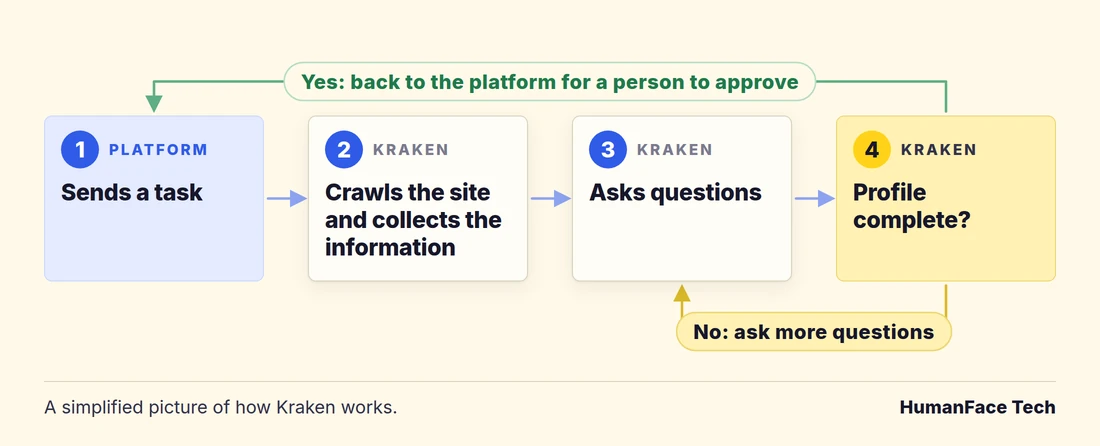
- A task arrives. The platform asks Kraken to build a profile for one clinic and points it at the clinic's website.
- Kraken crawls the site. It goes through all of the clinic's pages and collects what it finds into a searchable knowledge base for that clinic.
- It asks questions. Kraken puts questions to the knowledge base, such as what the clinic offers and who works there.
- It checks the profile. If something is missing, it asks more questions. Once the profile is complete or the task is done, it hands the result back.
- A person approves. Someone on the platform checks the profile and approves it.
What it runs on
Python and LangChain.


